As far as I’m concerned, 1983 was kind of perfect. I was eight years old, Luke Skywalker was taking on the empire in ‘Return of the Jedi’, I had a BMX, and Aberdeen FC had lifted the European Cup Winners Cup by beating the mighty Real Madrid in Gothenburg.
Around that time, something that felt much less exciting also happened, and little did I know the pleasure it would bring in the years ahead. I can’t remember who donated them but every pupil at Papdale Primary School was given a tree to plant at home. For our household this meant three trees with my older brother and sister also receiving one. I’m still not convince this is true and that my mum has this wrong but she assures me that my tree died! A large, strong sycamore grows in the front garden but in all the years it’s been there I’ve barely seen a bird in it.
Not so in the back garden however where a Scandinavian whitebeam grows. It too has its own story, saved from the chop by my little sister, Jacqueline. Growing right next to my dad’s shed and encroaching ever closer each year, his announcement that he was going to cut it down was met with horror and a threat from Jacqueline that she would tie herself to the trunk in order to prevent the felling!
Luckily for me it was growing right outside my bedroom window with the foliage at eye level. It hasn’t had many poor years in terms of berry production and has fed many a bird over the years. The holy grail and a favourite of my parents is the arrival of the waxwing. A more common sight was a blackbird feeding on the bright red berries. In some years the fortunes of the birds depended on whether the starlings could strip the entire tree before anything else could get there.
I’ve seen song thrush, greenfinch, chaffinch, bullfinch, chiffchaff, willow warbler, robin, dunnock, collared dove, woodpigeon, and fieldfare in there taking advantage of the bounty or using it to sing from. One of my favourites to frequent the tree however is an autumnal migrant from Scandinavia, the redwing. The redwing is a beautiful wee thrush with a creamy strip above its eye, orangey-red flanks, dark brown above, and a streaky chest. They like to migrate at night and on the ‘right’ evening you can hear them keeping in touch with each other with a distinctive high pitched “tseep” call.
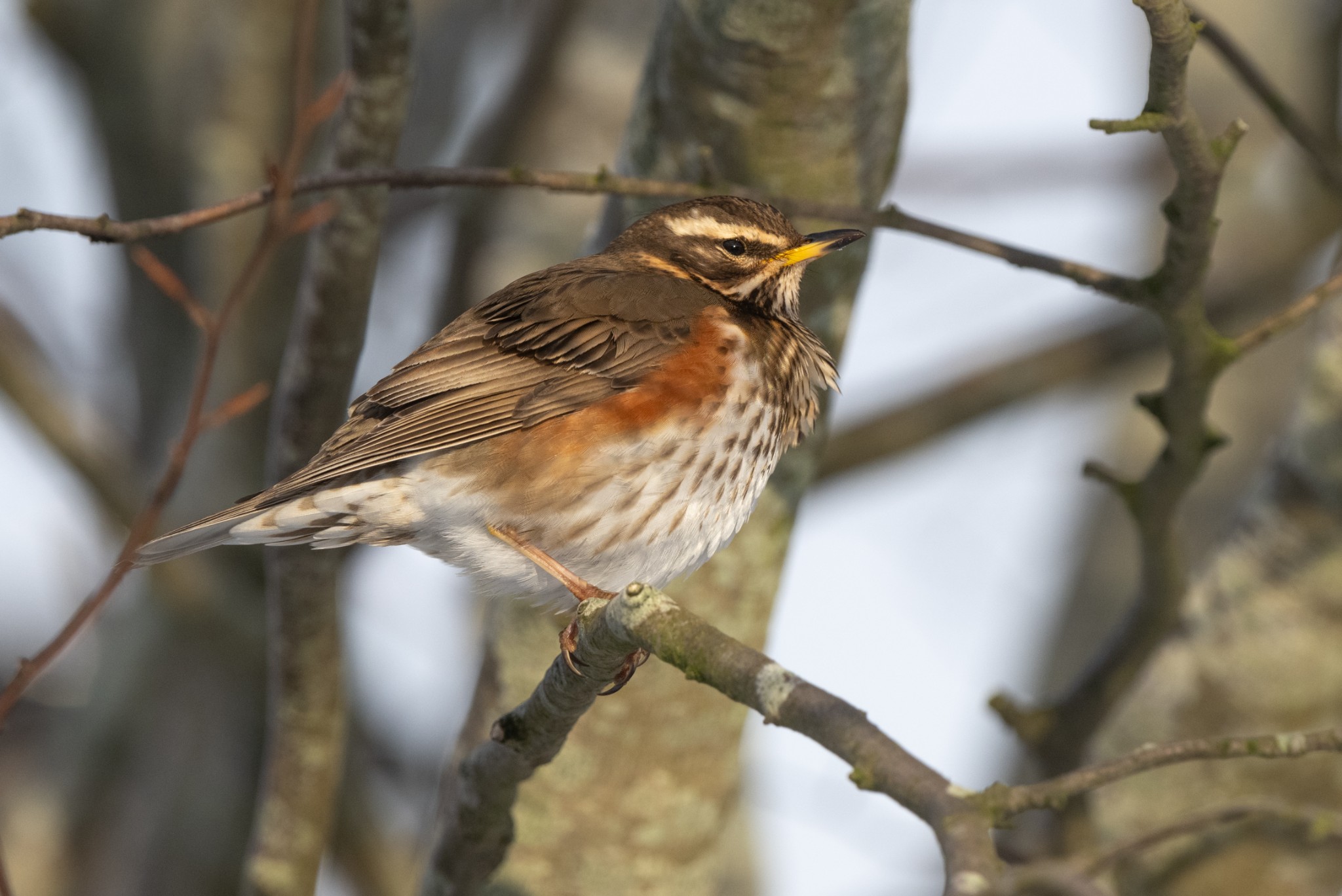
Orkney has recently seen quite an influx of this smart looking thrush but they’ve proved something of a challenge to photograph and made me think about when to put the camera down, or even lift it in the first place. Late October saw the arrival of our first named storm ‘Austen’ quickly followed by ‘Boelo’ and quite frankly some pretty rotten weather, with very high winds and heavy downpours.
Large flocks of redwing, accompanied by smaller numbers of blackbirds and fieldfares, were evident during this time. They are highly nomadic and move quickly around the countryside in search of berry laden trees and bushes. The flocks I’ve seen have been skittish and so almost impossible to photograph; once I stopped to lift the camera they were off.
It’s thought that up to 700,000 redwings spend the winter in the UK, hailing from Scandinavia and Russia, but there is another population which breeds in Iceland and the Faroes and it was birds from there that gave Orkney bird recorder Steve Dudley a fantastic experience on a wild Westray day. In his own words:
“A magical and unforgettable morning earlier when it rained 3600+ Icelandic redwings in just 40 minutes here in Westray. All coming from the same area of sky like some portal had been opened and down they streamed, hundreds at a time, landing in the bushes around me.”
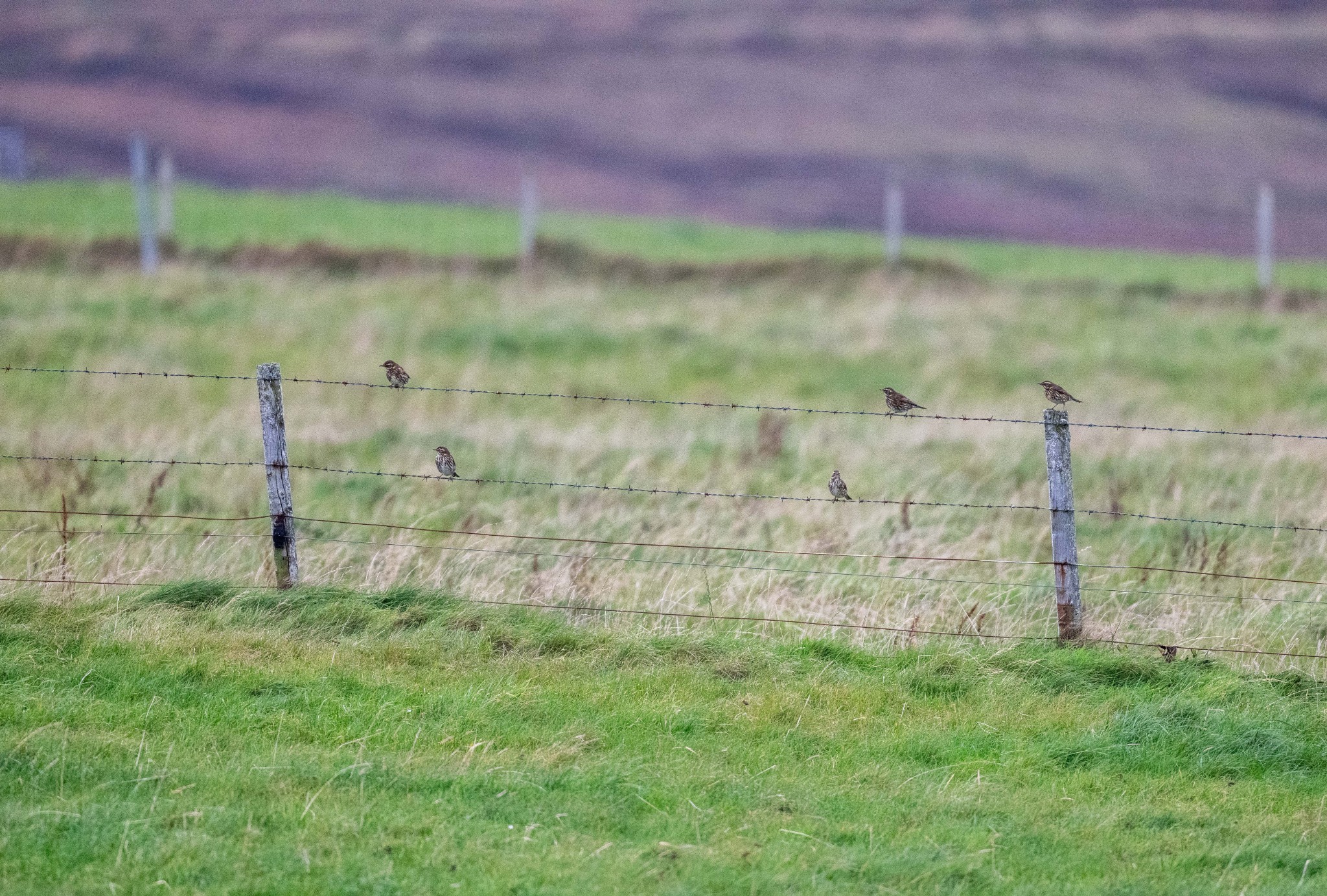
Steve’s experience made me think about my own a few days later as I watched the whitebeam sway back and forth, laden with redwings and fieldfares, from the comfort of my parents’ kitchen. The birds were moving so quickly I initially mistook them for large leaves shooting past in the gale force winds, five landing, strip a few berries, gone, a gust of wind and five more landing then gone. It was dark and the wind was accompanied by sideways rain, and I cursed internally that I couldn’t get any pictures of them, but did I really need to?
A photograph could never convey what I was seeing in front of me and what I was seeing felt special. The weather and wind direction has been such a mess that both Icelandic and Scandinavian birds have been mixed up together and with them have come some real rarities, thrushes from central Siberia, namely a dusky thrush in North Ronaldsay and a black throated thrush in Finstown. Some keen eyes however noticed certain anomalies with the plumage of the black throated thrush that led to some interesting discussion that it may be a hybrid and that hybridisation with other thrushes from central Siberia often takes place, namely red-throated, dusky and Naumann’s thrush.
The other thing I used to get excited by during the bird migrations of the early 1980s was hearing whooper swans overhead and rushing out of the house to see them. It’s been a real joy to see so many whooper swans, accompanied by their young of this year, feeding in Orkney’s stubble fields recently.
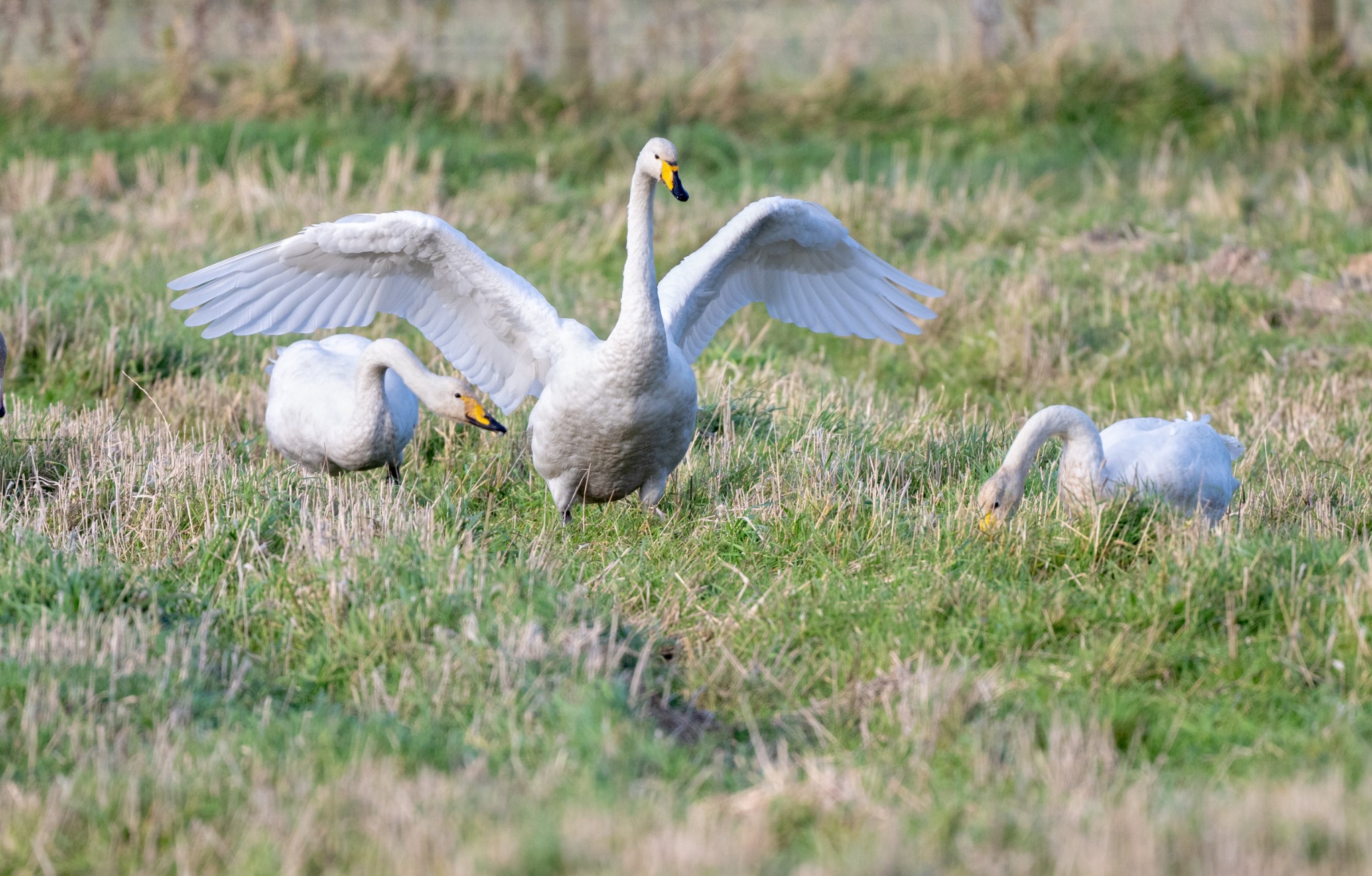
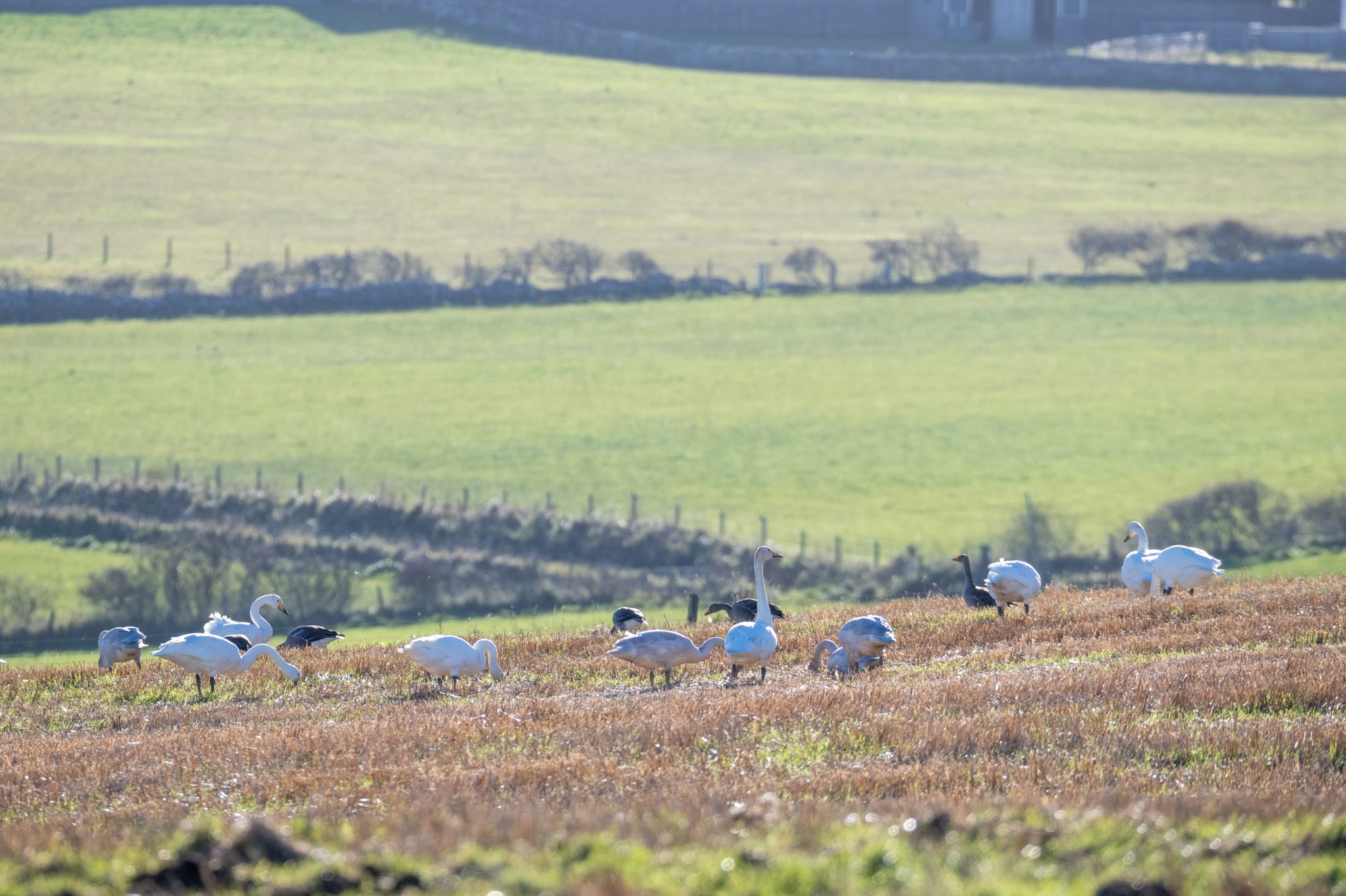
The whooper swans we see come from Iceland where they are thought to be doing well and hence the increase in the number of birds wintering in the UK. Whilst mute swans can also sometimes be seen in fields you can tell the whooper apart by its long neck, which it holds straight, and its black bill with bright yellow triangular patch.
They can be noisy too and there’s nothing that says winter more to me than a flock of bright white, noisy whoopers overhead in a blue sky on a crisp day, I never tire of seeing them.
I did see something new and exciting recently, albeit in a familiar place in Deerness; a tiny owl called a Eurasian scops owl. Its mottled grey plumage much like tree bark provided it with brilliant camouflage and offered birders much joy during the time it was here.
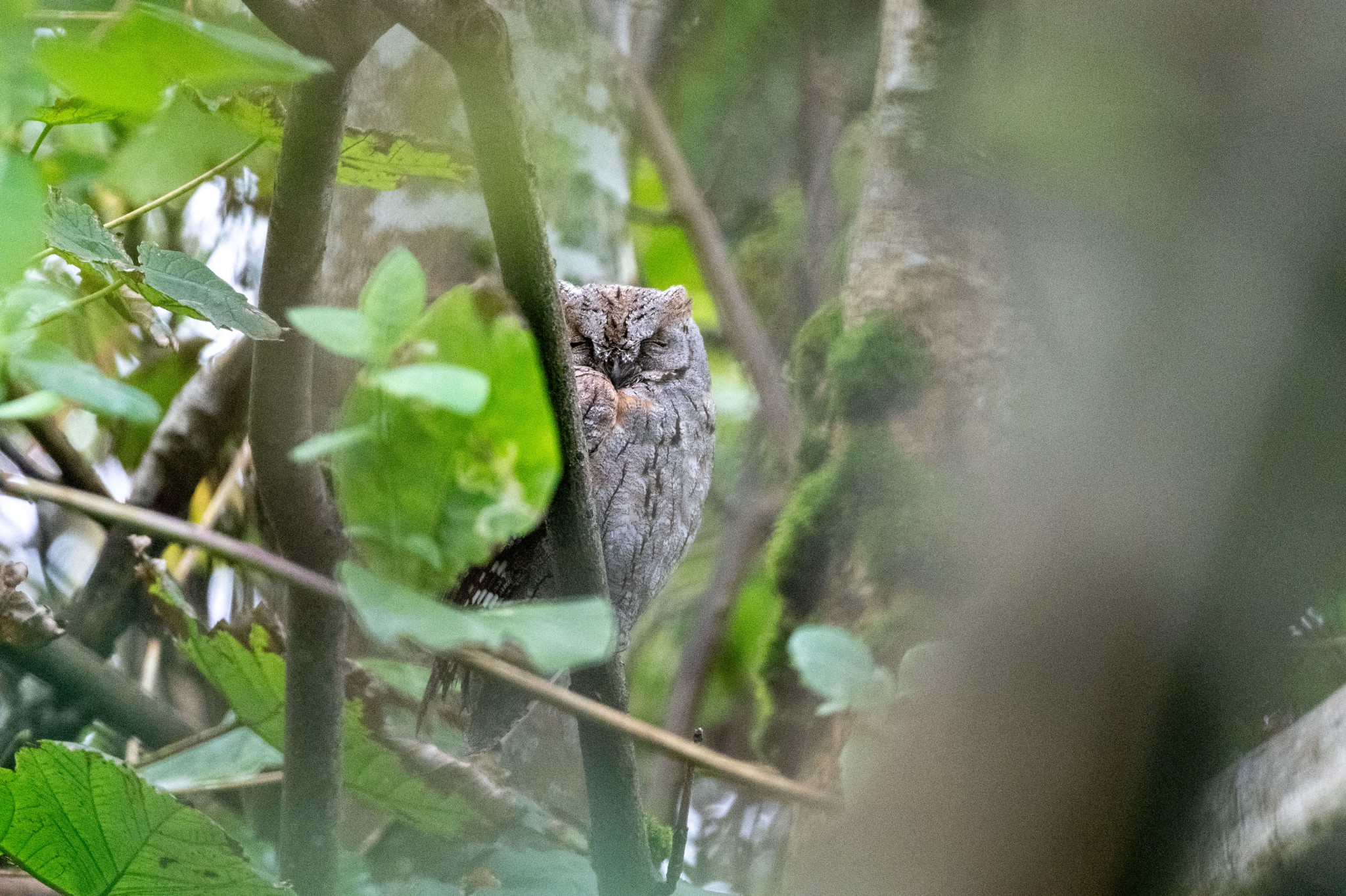
A small owl (even smaller than a little owl) found in southern Europe and normally wintering south of the Sahara Desert, it wasn't so easy to photograph through the thick cover but I was delighted to have had a glimpse. This is the ninth county record for Orkney, the last sighting being in 2014 (thanks to Steve Dudley for the records).
Raymond is a wildlife filmmaker who also offers bespoke Orkney wildlife tours and one-to-one wildlife photography tuition. Find out more via his official website. You can also find him on Facebook, Twitter and Instagram.